
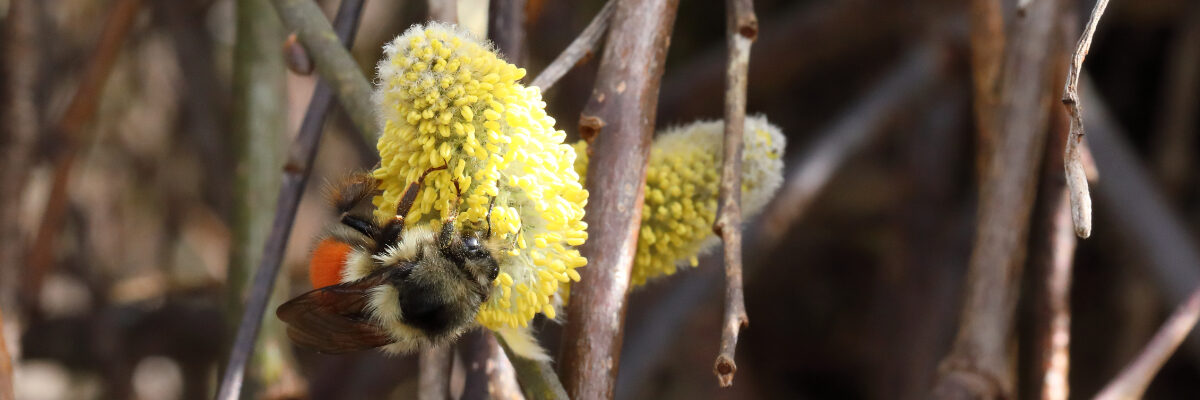
In March we salute our first bumblebees, the queens newly-emerged from their winter hibernation. The success of our bumblebee population depends on the ability of these amazing bees to independently build a nest and raise the first generation of workers. They then must lay successive clutches of eggs until August, when the young hatch as males and new queens. If the queen fails at any point in this cycle, her colony will die. In the fall, the colony will die regardless, but if new queens are hatched, they will pick up the cycle for the next season.
We recognize bumblebees as roundish, fuzzy, colourfully-striped and very loud. The queens are HUGE: at 15 to 25 mm, they can be twice the size of their first young.
Last fall, these queens had three tasks: to build enough body fat to survive the winter, to mate and store sperm in their bodies, and to find a safe place to hibernate.
The queens’ first priority on emerging in spring is to find the nectar they need after the long winter’s fast. Then, they search for a nest site and collect food for their first young and themselves. They lay eggs and keep them warm. Once the eggs hatch, the queens must keep the nest warm but also leave periodically to bring back more food.
The next bumblebees we will see are the first workers, who emerge in six weeks or so and take on the task of bringing food back to the nest. In our area, the first workers emerge in May, and their numbers increase through the summer with each new clutch of eggs laid by the queen.
What can you do to help the queens? You can:
- Protect places where they can overwinter. Delay removing leaf litter until spring clean-up in late April.
- Provide food by growing plants that offer early pollen: crocuses, winter heather, japonicas, and willows.
- Maintain opportunities for spring nest sites such as areas of long grass, compost piles, and abandoned rodent holes. Try building a bumblebee nest: there’s no guarantee of success, but you’ll have fun.
- Learn more. The Bumblebee Conservation Trust has published a more complete description of the bumblebee life cycle.
- Join our volunteers who are working to promote the interests of pollinators in Squamish. Watch our newsletter and social media for more information.
Thanks for caring about our bees.


Photo above used by permission: An orange-rumped bumblebee (Bombus melanopygus) queen foraging on March 28. She is nectaring to feed herself and has not yet begun to collect pollen for her first clutch of eggs. We’re suggesting this because her pollen basket (the red hairs curving off her hind leg) does not appear to have been used yet.