
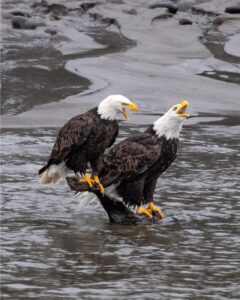
 Bald eagles are one of the most iconic species of raptors seen across North America. Here in Squamish, we’re lucky to experience bald eagles year-round! During spring and summer, eagles are frequently seen flying, roosting, hunting and nesting throughout the Sea to Sky corridor. During the rainy and cold winter months, hundreds of eagles are present around the Squamish River after completing their fall migration to overwinter here. Eagles take advantage of the mild and oceanic climate of the Squamish Valley to survive the winter. There is suitable habitat with spawning and spent salmon to sustain a large overwintering population of eagles. Late in the season, eagles tend to move upriver to more sheltered spawning channels: that happened again this season, even though there was still food available in the lower part of the river.
Our season ran from Saturday, November 2 to Saturday, January 4. This 29th season of EagleWatch was our fifth as a citizen science initiative. A total of 30 volunteers counted on a twice-daily schedule, recording the number of adult and juvenile eagles present within a standardized counting area at Eagle Run Viewing Dike in Brackendale.
This season’s highest count of 78 was recorded on November 20. The two lowest counts of four eagles occurred back-to-back on December 31 and January 1. Eagles were seen during all 128 counting shifts. This season had our second highest total count in the last five years. Our experience has confirmed that the best eagle viewing at Eagle Run occurs in the mornings, between early November and mid-December, and that more adults than juveniles are typically seen.
EagleWatch was followed by the Annual Brackendale Winter Eagle Count on Sunday, January 5 when 64 volunteers counted throughout the Squamish Valley. The total was 1288 bald eagles, our highest annual count since 2007!
The Squamish River is a dynamic ecosystem, and the presence of bald eagles along Eagle Run dike is known to be affected by extreme weather events, salmon runs, and general human impact on the watershed. EagleWatch hopes to educate the community about bald eagles for years to come, through counting the birds and reporting local environmental factors to help better understand the overwintering ecology of bald eagles in Squamish.
Nature Squamish and EagleWatch extend a big thank you to our EagleWatch volunteers. Without your continued interest and dedication, this program would not be possible. We appreciate the countless hours you’ve spent looking through binoculars for eagles.
Our 30th season will commence on Saturday, November 1. Come count with us! We welcome new and experienced birders and offer training through social counts. To inquire, please contact eagle-watch@squamishenvironment.ca, or send us a message on social media!
Read the full report for the 2024 – 2025 EagleWatch season.
Photo above by George Carr: adult bald eagles in Brackendale BC